




Be Ready for Life’s Big Moments
How a smart investment strategy can help you prepare for major expenses
Picture the scene: your daughter and her partner announce, “We’re getting married.” The first response is joy. For many families, however, a second thought follows quickly: has our investment strategy got this covered?
A wedding is only one major financial milestone. Education, moving home, a business transition and retirement can all involve significant expenditure. They may be years away, but are often foreseeable. The question is whether the money intended for them is simply waiting in cash, or working in a way that reflects when it will be needed.
Cash has an essential role: certainty, liquidity and a reserve for unexpected costs. It is the appropriate home for money needed soon, such as an emergency fund, a tax bill or a wedding payment. However, holding adequate cash for short-term commitments differs from leaving longer-term capital in an account with limited scope to grow.
If savings earn around 0.30%, or even 3% (through a digital deposit platform), consider whether money not needed for several years could be positioned differently. This does not mean investing every euro. The right approach depends on the timeframe, your objectives, capacity for loss and comfort with market volatility.
Match the investment strategy to the event
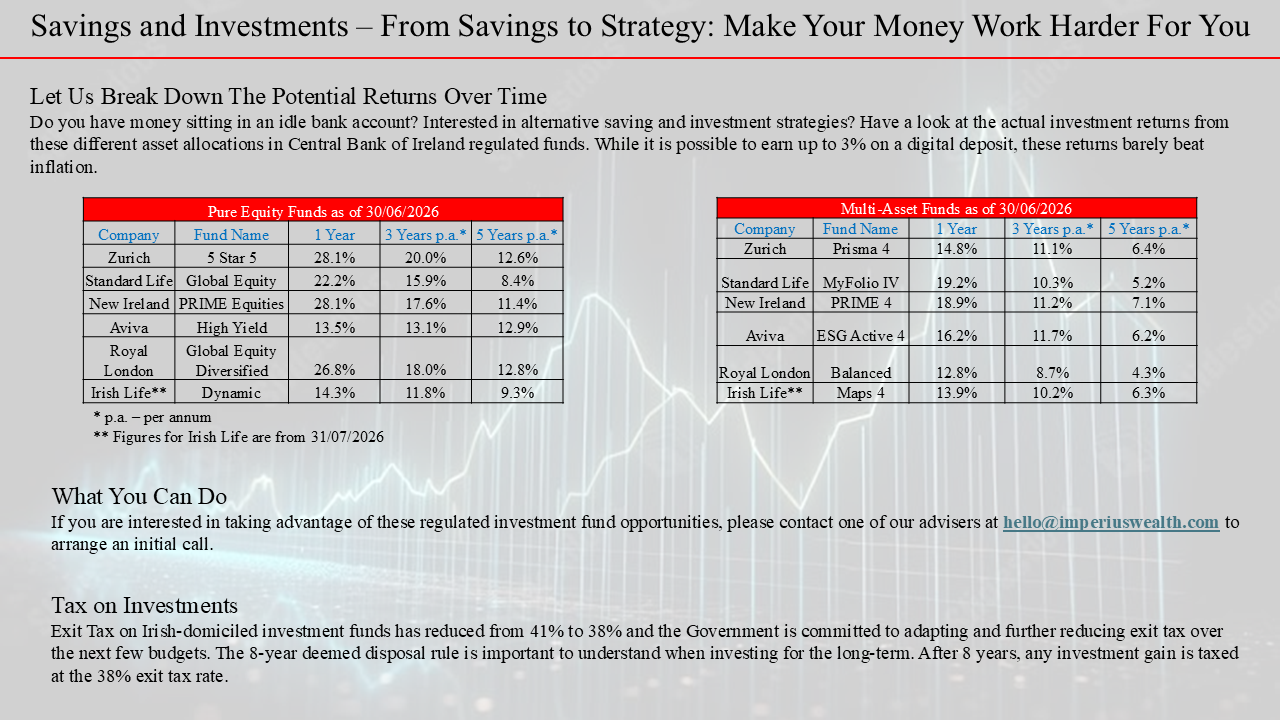
A summary of Central Bank of Ireland-regulated Pure Equity and Multi-Asset funds illustrates why cash need not be the default for longer-term savings. These figures are a snapshot, not a forecast, but demonstrate investing’s different growth potential – and risk.

Important: The performance figures shown are gross, before annual management charges, which are typically up to 1.5% p.a. A 1% Government Levy also applies on the purchase of an investment.
Click here to see the full table of fund performance
The Multi-Asset group offers a useful example of a balanced approach. Its three-year annualised returns ranged from 8.7% to 11.7%; the five-year range was lower, at 4.3% to 7.1%. This reminds us that market returns vary by period, although every fund in the comparison exceeded a hypothetical 3% annual deposit rate over five years.
Multi-Asset funds typically combine shares, bonds and cash. Diversification seeks growth while reducing the impact of weakness in one asset class, but it cannot eliminate risk or prevent losses.
For investors with longer horizons and a higher tolerance for volatility, Pure Equity funds provide greater exposure to stock markets. Returns can be stronger, but values can also move more sharply. In the supplied comparison, the group returned 11.8% to 20.0% a year over three years and 8.4% to 12.9% over five. Choose a strategy that suits the investor and the mission—not simply the latest table-topper.
Plan ahead without losing flexibility
Investing does not necessarily mean locking money away indefinitely. Many open-ended retail funds allow redemptions, subject to dealing, settlement, charges and other conditions. Depending on the fund and provider, proceeds can typically be accessed within 3–5 working days; the exact terms should be checked before investing.
The key is to distinguish money needed soon from money with time to absorb market movements. Short-term money generally belongs in cash. Capital intended for a known event further ahead may pursue longer-term growth, provided the risk level is appropriate.
Build an investment strategy to deal with what you know is coming
In life, we can generally see the milestones ahead of us. The prudent response is not to chase the highest-performing fund, but to create a plan: cash for certainty and near-term spending, with an investment strategy for money that has a longer job to do.
A conversation with an adviser can help identify milestones, clarify your cash reserve and assess whether a Multi-Asset or equity-led approach suits your objectives. Plan before the expense appears and give your money more opportunity to support the life you are building.
Investing does not necessarily mean locking money away indefinitely. Many open-ended retail funds allow redemptions, subject to dealing, settlement, charges and other conditions. Depending on the fund and provider, proceeds can typically be accessed within 3–5 working days; the exact terms should be checked before investing.
The key is to distinguish money needed soon from money with time to absorb market movements. Short-term money generally belongs in cash. Capital intended for a known event further ahead may pursue longer-term growth, provided the risk level is appropriate.
Speak to an Expert
Let’s Talk to arrange a consultation with our team today.
Past performance is not a reliable guide to future performance. The value of investments can fall as well as rise, and tax treatment depends on individual circumstances and may change.
This article is for general information only and is not personalised financial advice.
Source: Supplied fund-performance summary. Results are as at 30 June 2026, except Irish Life figures, which are as at 31 July 2026. “p.a.” means per annum.