




If you’ve had €100,000 in an Irish bank deposit account for the last 3 years, you’ve left €27,771 on the table
For Irish savers, a comparison of three options over the three years to 30 June 2026 shows how significant the difference can be between leaving €100,000 in a bank deposit and investing through a multi-asset fund.
Multi-Asset Funds have outperformed Irish and EU Digital Deposit Accounts
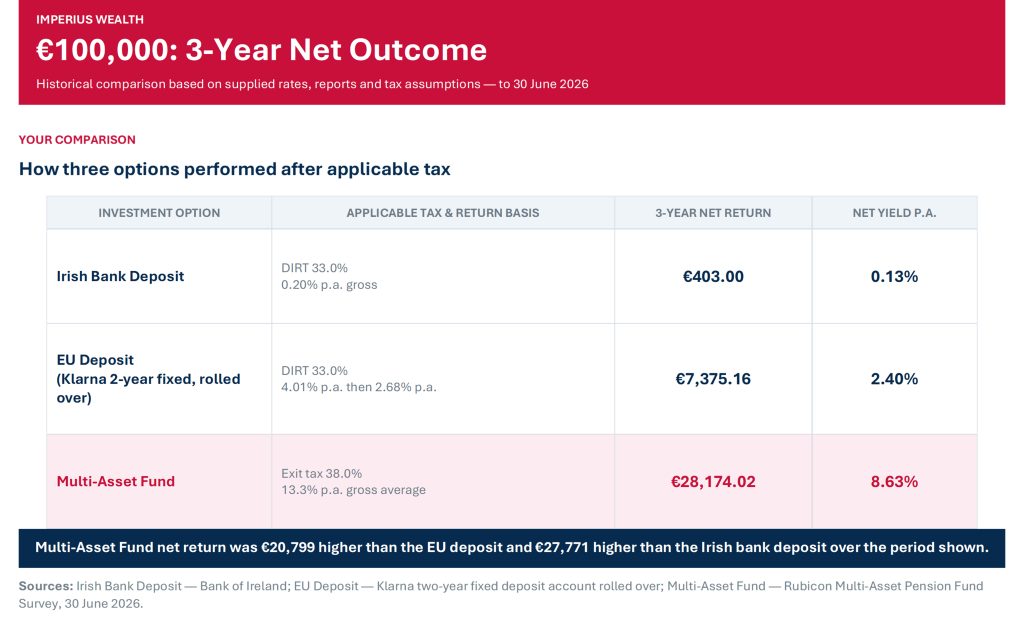
On the historical rates, returns and tax assumptions shown above, €100,000 invested in a multi-asset fund generated a net gain of €28,174.02 over three years. This represents a three-year net return of 28.17% and a net annualised return of 8.63%.
The same capital held in a low-rate Irish bank deposit paying 0.20% per annum generated a net gain of only €403.00, or 0.13% per annum after annual DIRT.
In net cash terms, the historical multi-asset fund result was €27,771 ahead of the low-rate Irish bank deposit and €20,799 ahead of the EU digital deposit account.
Over the three years to 30 June 2026, the multi-asset fund also comfortably outperformed the EU Digital Deposit comparator. While the Klarna fixed-deposit account—rolled over at maturity—produced an estimated net gain of €7,375 on a €100,000 investment, the multi-asset fund delivered a net gain of €28,174 after exit tax. That is a difference of almost €20,800 in favour of the Multi-Asset Fund.
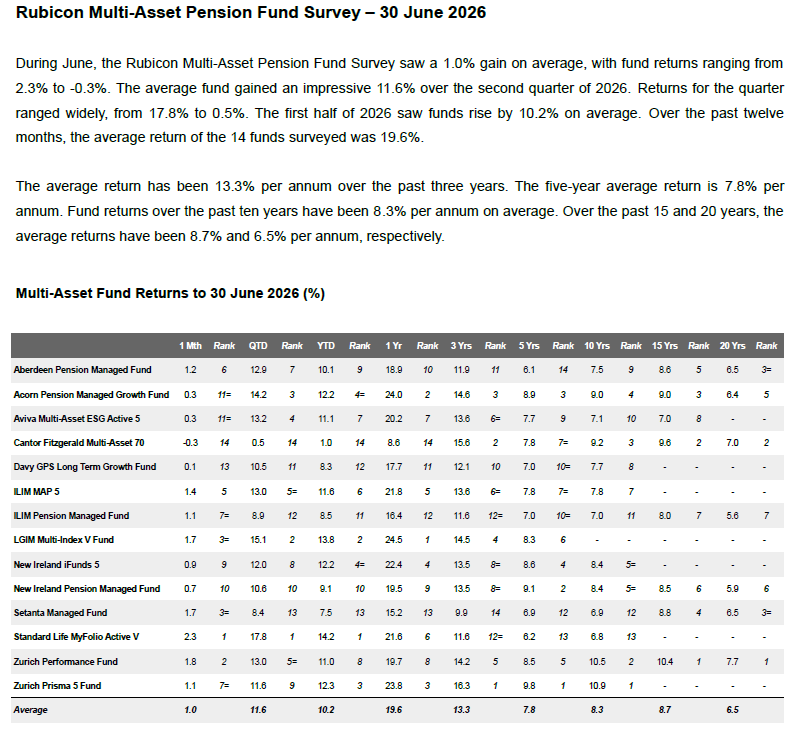
To avoid ‘cherry-picking’, we have taken the average performance of a series of Multi-Asset Funds analysed by Rubicon.
This is an historical comparison rather than a forecast, but it illustrates how a diversified, long-term investment approach can offer greater growth potential than cash deposits for money that is not needed in the short term.
That is a lot of money to be leaving on the table.
Cash has its place
This does not mean that cash has no place in a financial plan. Deposits may be appropriate for emergency reserves, short-term commitments and capital that must be available at short notice. They are straightforward and, subject to the relevant product terms and deposit-guarantee limits, offer a different risk profile from market-based investments.
Yet cash held for longer periods can bring a separate risk: returns may not keep pace with inflation and the future cost of living.
The comparison is an historical illustration, not a forecast. It records what the stated €100,000 would have delivered over the three-year period using the rates, performance and tax treatments shown. The arithmetic cannot predict the next three years. It does, however, demonstrate the tangible effect that return, compounding and taxation can have on a substantial sum of money.
Tax is an important consideration
The low-rate Irish deposit calculation applies DIRT at 33% annually. The Klarna fixed-deposit illustration provides for 33% Irish DIRT on interest earned in each period. In the multi-asset fund example, exit tax of 38% is applied at the end of year three. The 13.3% p.a. three-year average reported in the Rubicon survey therefore translates to the stated net outcome only after the assumed exit-tax treatment.
Past performance is not a reliable indicator of future performance. The value of investments can fall as well as rise, and investors may get back less than they invest. Multi-asset funds carry market risk; returns are not guaranteed, and tax treatment may change. Deposit rates, product terms and the protection available to depositors may also change.
The appropriate option depends on your timeframe, liquidity needs, attitude to risk, existing assets and financial objectives. Before moving money from cash to investments, obtain advice that considers your individual circumstances and builds an appropriately diversified plan.
Speak to an Expert
Let’s Talk to arrange a consultation with our team today.
Past performance is not a reliable guide to future performance. The value of investments can fall as well as rise and Exit tax treatment on gains applies (currently @ 38% but this can change. )
This article is for general information only and is not personalized financial advice.